Sanctions Desk gathers and checks the evidence for every sanctions-screening alert and recommends an outcome; a person with the right entitlement approves it. One alert, start to finish · The problem it works on
Sanctions Desk / Architecture
Architecture
Six diagrams, each drawn from the code it shows (the sources are in the repository, rendered with Mermaid). Every label names a step, role or model as the code does.
How a review runs
The desk's agents read the bank's data only through Zetaris. The raw free text (notes, payment references, list remarks) is read by Nemotron 3.5 Lightning on the analyst's machine; the decision, critic and challenger send only structured facts to Nemotron 3 Ultra in the cloud (in every run with the screener; for the four early runs made before it existed, see earlier runs). A raise-only policy guard checks the result, and a person decides.

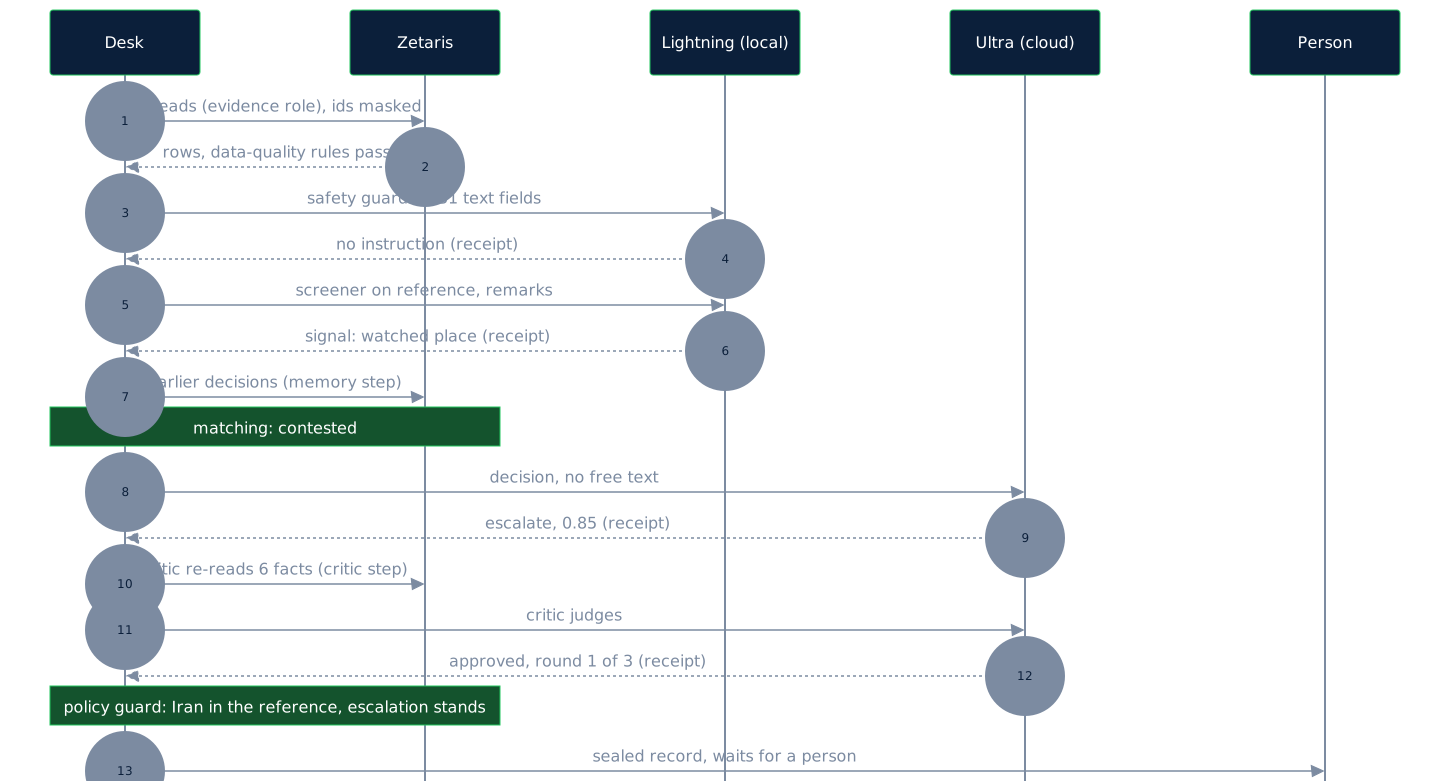
One live review, step by step
The live review of alert ALR-0073: every Zetaris read and the role it ran under, every model call with the model that answered and its signed receipt, the critic's check, and the sealed record waiting for a person.
Every failure ends in a hold, never a close
Zetaris down, a data-quality failure or a cut-off list, a guard flag or no answer, an answer for raw text served from the cloud, a screener signal, a model that does not answer, a critic that does not approve, a credible challenge: each one holds or escalates the case. A block, or an override to a close, waits for a second approver.

The life of an alert
An alert is reviewed, its recommendation sealed, and a person decides; a block or an override to a close waits for a second approver. A change in a listed entry lists earlier decisions for a person, on request. Automatic closing exists but is off by default.

Where customer data goes
Identifier numbers are masked as they are read. The raw free text goes only to the local model; every cloud prompt is checked for it before it is sent. The trace keeps ids and counts, the sealed record what an auditor needs, and receipts only the start of each prompt. Details: docs/PRIVACY.md.

Who may read what in Zetaris
Each review step that reads data has its own non-admin Zetaris role with only its tables; Zetaris itself refuses every other table and every write (85 of 85 checks).
